The range hood filter is the one kitchen component that is designed to get filthy, and the one almost nobody cleans. Left long enough it stops trapping grease, which then lands on your cupboards, walls and ceiling instead.
Most homeowners are diligent about benchtops and stovetops. The filter sits above eye level, out of sight, quietly loading up with oil, dust and cooking residue.
Five signs it is overdue
| Sign | What it means |
|---|---|
| Sticky grease on the splashback or nearby cupboards | The filter is saturated and no longer catching what it should — the grease is landing elsewhere |
| Weaker suction, or a louder fan | The motor is working against a blocked filter |
| Cooking smells lingering for hours | Air is not being drawn through and extracted properly |
| The filter looks dark, sticky or discoloured | Look underneath the hood; if it looks bad it is well past due |
| Steam and smoke spreading across the kitchen | Not being pulled upward, which is the filter's entire job |
Why this one matters more than it looks
Accumulated grease is flammable, and a loaded filter sits directly above an open flame or element. This is the strongest practical argument for cleaning it on a schedule rather than when it looks bad.
What the filter is actually doing
It is the first line of defence against airborne grease, smoke and heat. In a household that cooks daily it works constantly, trapping oil particles before they spread across cabinets, ceilings and walls. Clogged, it stops doing that — and everything it would have caught goes somewhere else in your kitchen.
Our process
- Pre-inspection and removal — filters removed and checked for the level of build-up and their structural condition, which decides the approach.
- Degreasing soak — soaked in a degreasing solution that dissolves built-up oil and cooking residue, loosening what is stuck in the mesh layers.
- Deep scrub — specialist brushes work the remaining grease out of the mesh; stubborn areas get targeted steam treatment.
- Rinse and dry — rinsed thoroughly to remove all cleaning agents, then dried completely before it goes back.
- Reinstallation and check — refitted, the fan tested, and the outer surface of the hood polished.
Not all filters are the same
Which filter you have changes how it should be cleaned, and how often it needs doing.
| Type | How to recognise it | Cleaning |
|---|---|---|
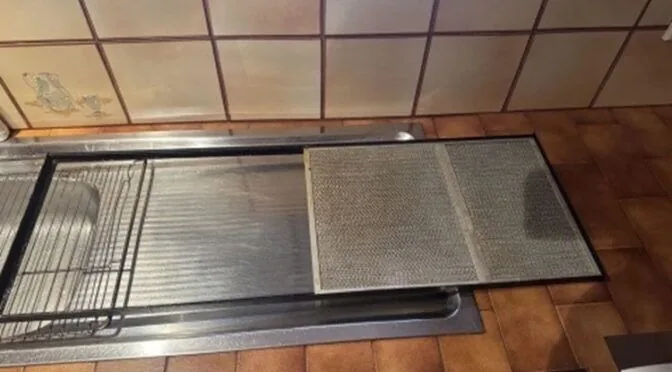
| Aluminium mesh | Layers of fine mesh in a light frame, the most common domestic type | Soaks and scrubs well; can discolour if put through a dishwasher repeatedly |
| Baffle | Solid overlapping metal blades rather than mesh, usually stainless | Robust, soaks well, and generally the easiest to bring back |
| Charcoal / carbon | A sealed cartridge, used on recirculating hoods with no external duct | Not cleanable — it is designed to be replaced, and cleaning it does nothing |
If yours is charcoal
A recirculating hood with a carbon cartridge cannot be restored by cleaning. The cartridge is consumed and needs replacing on the manufacturer's interval. We will tell you if that is what you have rather than washing it and handing it back.
A realistic maintenance interval
| Cooking pattern | Filter interval | Why |
|---|---|---|
| Frying or wok cooking most nights | Every 2 to 3 months | High-temperature oil puts the most airborne grease into the hood |
| Cooking most nights, mixed methods | Every 3 to 4 months | The typical household pattern |
| Cooking a few times a week | Every 6 months | Slower loading, but it still accumulates |
| Rarely cook at home | Annually | Dust becomes the main issue rather than grease |
Whatever the interval, the sign to act on is the one you can see: if the filter looks dark or feels tacky, it is already past due.
Why it is worth handing over
| At home | Professionally | |
|---|---|---|
| Soak | Sink or laundry tub, limited by what it will hold | Proper container and solution |
| Solution strength | General degreaser | Trade degreaser matched to the build-up |
| Stubborn areas | Scrubbing, repeatedly | Targeted steam treatment |
| Time | The soak alone takes most of an evening | Handled as part of the visit |
| The mess | In your kitchen | Not in your kitchen |
We clean range hood filters as part of a deep clean, or on request within regular cleaning in Croydon. Ask when you book so we allow time for the soak.
Frequently asked questions
How often should range hood filters be cleaned?
Every three to six months for a household that cooks most nights, and more often if you fry or wok-cook regularly. Once you can see it, you are well past due.
Can filters go in the dishwasher?
Some can, and it helps with light build-up. On a heavily loaded filter it mostly redistributes grease around the dishwasher, and aluminium mesh can discolour.
What if the filter is damaged?
We check the structural condition before cleaning. A mesh that has collapsed or corroded will not seal properly again and needs replacing — we will tell you rather than clean it and hand it back.

3 Piglets Cleaning
We are a Croydon-based cleaning company serving Melbourne's eastern and south-eastern suburbs. Our technicians are police-checked and fully insured, and those working with NDIS participants and older clients hold NDIS Worker Screening Clearances. More about us.