Cleaning can spread contamination as easily as it removes it. The four habits below — colour coding, working in one direction, respecting dwell time and handling waste last — are what separate a hygienic clean from a tidy-looking one.
In aged care settings and in the homes of older clients, this matters more than it does in an average household. Below is what our technicians actually do, and why each step exists.
1. Colour-coded cloths and mops
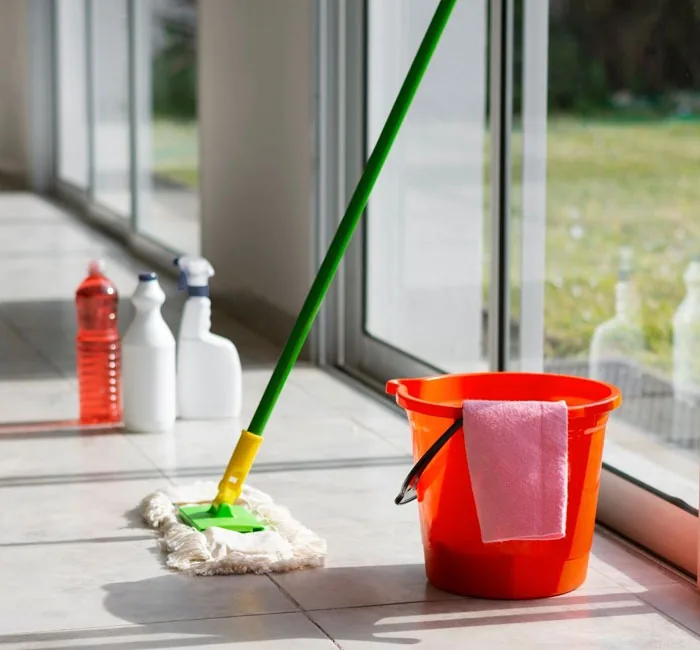
The single most common way cleaning spreads contamination is one cloth travelling from the bathroom to the kitchen. Colour coding removes the judgement call entirely: the cloth for a given area is a given colour, and it never leaves that area.
| Colour | Where it is used | Why it is separated |
|---|---|---|
| Red | Toilets and the area immediately around them | Highest contamination risk in the building |
| Yellow | Basins, showers, baths and other bathroom surfaces | Wet-area contamination, but not toilet-level |
| Blue | General surfaces, dusting, low-risk rooms | Living areas, bedrooms, hallways |
| Green | Kitchen and food preparation surfaces | Food safety — never touched by anything from a wet area |
Cloths go into a bag for laundering after the area is finished. They are not rinsed and reused in another room, because rinsing does not reset a cloth.
2. Work in one direction, top to bottom, clean to dirty
A clean should move through a space once, in a single direction, from the cleanest area to the dirtiest and from the highest surface to the lowest. That way nothing already cleaned gets re-contaminated by what comes after it.
3. Give the product time to work
Most cleaning products need to stay wet on the surface for a stated period before they do what the label says. Spraying and immediately wiping removes visible soil but wastes the product's actual function. This is called dwell time, and it is on the label of every product we carry.
Why this is the step people skip
Dwell time feels like doing nothing. It is the difference between wiping a surface and actually cleaning it, and it is the easiest corner to cut when someone is in a hurry. Our technicians work to a checklist partly so this step does not get lost.
4. Handle waste and laundry last, then wash hands
Bins and used linen are done at the end of the visit, not partway through, so nothing already cleaned is touched afterwards with contaminated gloves.
- Bins emptied and relined at the end of the room, not the start
- Bags tied before they leave the room, not carried open through the house
- Used cloths bagged separately from general waste
- Gloves changed between wet areas and food-preparation areas
- Hands washed after gloves come off, every time
- Equipment cleaned and dried before it goes back in the vehicle
We are cleaners, not carers
3 Piglets Cleaning is a cleaning business. We clean the home and keep it comfortable and easy to move around in. We do not provide personal care, nursing, medication support or any form of medical assistance, and nothing on this page should be read as health advice.
How this looks on a real visit
On an aged care visit in a private home, the practical result is that the bathroom gets its own cloths, the kitchen gets its own cloths, floors are done last and left dry, and the bins go out on the way past the door. None of it is complicated. It just has to be done in the right order, every time, which is what a written checklist is for.
We provide aged care cleaning across Melbourne's eastern suburbs from our base in Croydon. If you would like to talk it through, get in touch — there is no pressure either way.
Frequently asked questions
Does colour coding actually make a difference in a private home?
Yes. A single home still has a toilet, a shower and a kitchen bench, and a cloth that travels between them carries contamination with it. The system exists precisely so nobody has to remember which cloth went where.
What is dwell time?
The time a product needs to stay wet on a surface to do its job. It is stated on the product label and it is usually longer than people expect. Wiping immediately after spraying removes soil but skips the product's actual function.
Do your technicians use the client's own products?
We bring our own, but we are happy to use yours if you prefer. Tell us before the first visit and we will note it on the file.
3 Piglets Cleaning
We are a Croydon-based cleaning company serving Melbourne's eastern and south-eastern suburbs. Our technicians are police-checked and fully insured, and those working with NDIS participants and older clients hold NDIS Worker Screening Clearances. More about us.