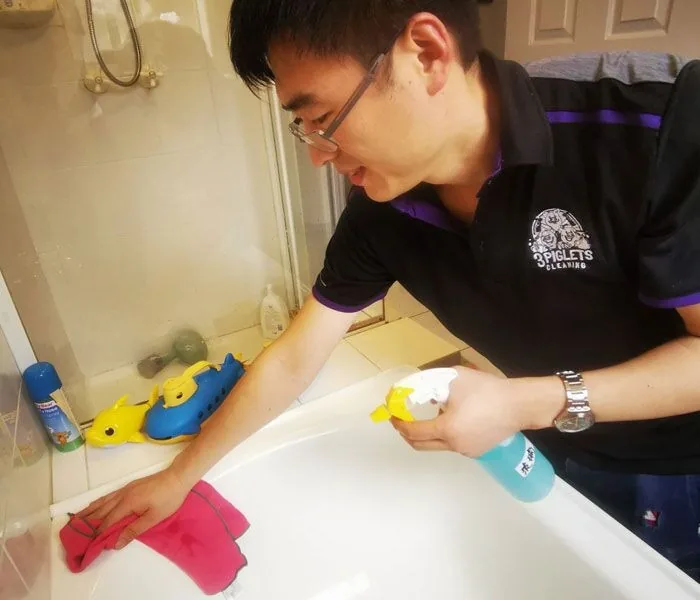
A proper bathroom clean is mostly waiting and agitating. Product goes on, other work happens while it dwells, then the softened soil gets brushed out rather than wiped over. Wiping alone never reaches into grout.
The order
| Step | What happens | Why here |
|---|---|---|
| 1. Ventilate | Window open or exhaust running | Moisture and vapour need somewhere to go |
| 2. Clear surfaces | Toiletries and mats moved out | You cannot clean around a full vanity |
| 3. Apply product | Shower, screen, basin, toilet sprayed | Dwell time starts now, not later |
| 4. High surfaces | Cabinet tops, exhaust cover, shelves | Dust falls; do it before the surfaces below |
| 5. Mirror and glass | Cleaned while product dwells | Uses the waiting time |
| 6. Shower and screen | Agitated, brushed along grout, rinsed | Cleanest fixtures first |
| 7. Basin and vanity | Bowl, tapware, benchtop, cabinet fronts | Working down the room |
| 8. Toilet | Bowl, seat, cistern, base, behind | Last fixture, dedicated cloths |
| 9. Floor | Vacuum or sweep, then mop to the door | Picks up everything dislodged above |
| 10. Replace and dry | Items back, floor dried | Left safe and as found |
Grout is where the time goes
Grout is porous. Soil sits below the surface, which is why wiping a tile makes the tile clean and leaves the line dark. It needs product with real dwell time and a stiff brush worked along the line, not across it.
Along the line, not across the tile
Brushing across tiles skips over the grout channel. Working along the length of the line keeps the bristles in the channel where the soil actually is.
The fittings that get skipped
- Shower screen bottom track, where water and soap collect
- The base of the toilet and the floor immediately behind it
- Underside of the toilet seat hinges
- Exhaust fan cover, which loads up with lint
- Tap bases, where mineral deposits build a ring
- Shower rose, which clogs with mineral scale
- Door handle and light switch on both sides
- The lip under the vanity benchtop
Where cleaning stops and a repair starts
Some bathroom problems are not cleaning problems, and it does nobody any favours to pretend otherwise.
| Problem | Cleaning job? | What it actually needs |
|---|---|---|
| Surface mould on tiles and grout | Yes | Product, dwell, agitation |
| Mould inside perished silicone | No | Cut out and reseal |
| Grout that is stained through | No | Regrouting |
| Grout that is cracked or missing | No | Regrouting; water is getting behind it |
| Etched shower glass | No | Replacement; a treatment slows further etching |
| Mineral scale on tapware | Yes | Mild acid, dwell, gentle agitation |
| Mould returning within weeks | No | A ventilation problem — check the exhaust |
Ventilation is usually the real issue
If mould comes back within a few weeks of a proper clean, the bathroom is not drying out. No cleaning schedule fixes that. A clogged or underpowered exhaust fan is the most common cause, and it is worth checking before paying anybody to clean more often.
We offer bathroom cleaning and shower screen treatment, and we will tell you when the answer is a trade rather than a cleaner.
We clean across Melbourne's eastern suburbs from our base in Croydon. Tell us what you need and we will come back with a clear answer, usually the same day.
Frequently asked questions
How long should a bathroom deep clean take?
Longer than most people expect — often an hour or more per bathroom if grout, seals and the screen are genuinely being done. A wipe-over is quick; this is not that.
Why does my grout go dark again so fast?
Either it is unsealed and reabsorbing, or the room is not drying out. The second is far more common and it is a ventilation problem.
Can you remove all mould?
From hard surfaces, yes. Mould that has gone into silicone or plaster needs cutting out and replacing, which is a repair rather than a clean.

3 Piglets Cleaning
We are a Croydon-based cleaning company serving Melbourne's eastern and south-eastern suburbs. Our technicians are police-checked and fully insured, and those working with NDIS participants and older clients hold NDIS Worker Screening Clearances. More about us.