Streaky windows are almost never a product problem. Nine habits cause nearly all of it, and the most common one is using too much cleaner rather than too little.
The nine
| Mistake | What it causes | Fix |
|---|---|---|
| Cleaning in direct sun | Solution dries before it can be removed, leaving film | Work on the shaded side; follow the shade around the house |
| Too much detergent | Residue film that shows as streaks at every angle | A few drops in a bucket; if streaking, use less not more |
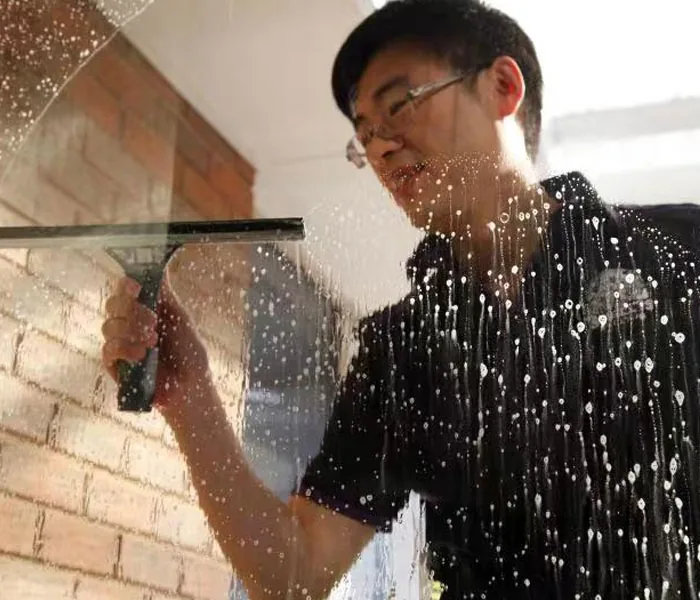
| Dirty or nicked squeegee blade | A line down the glass on every pass | Wipe the blade after every pass; replace it when it nicks |
| Skipping the track | Grit turns to mud and runs back down the glass | Vacuum the track dry before anything gets wet |
| Leaving flyscreens dirty | Clean glass still looks dirty from inside | Remove and wash the mesh, do not just brush it |
| Using paper towel | Lint left across the glass | Clean microfibre, or a squeegee and a drying cloth |
| Same cloth for frame and glass | Frame grime transferred onto clean glass | One cloth for glass, a separate one for frames and sills |
| Working bottom to top | Drips run down onto finished glass | Always top down |
| Not drying the edges | Water pools at the edges and dries as marks | A dry cloth around the perimeter, last |
The detergent one deserves its own note
It is counter-intuitive and it is the most common. When windows streak, the instinct is to add more cleaner. More cleaner means more residue, which means more streaks, which prompts more cleaner. Professionals use remarkably little — a few drops of dish soap in a bucket of warm water is a standard glass solution.
If you are streaking, halve the product
Then halve it again. You will be surprised how little is needed. The water and the squeegee do most of the work.
The right order
Two mistakes that cause damage rather than streaks
- Using ammonia-based cleaner on tinted glass — it destroys the film permanently
- Dry-scraping glass — a blade on dry glass scratches it, and scratches are permanent
- Using abrasive pads on frosted glass, which polishes the texture into shiny patches
- Pressure-washing windows, which forces water past seals and into frames
- Climbing on furniture or an unstable ladder to reach upstairs glass
The last one matters most. Second-storey windows are where window cleaning stops being a cleaning question and starts being a safety one. If you cannot reach it safely from the ground, that is a job to hand over.
We do window and gutter cleaning across Melbourne's eastern suburbs — glass, frames, sills, tracks and flyscreens. Ask us for a quote and we will tell you honestly what can be reached safely at your place.
Frequently asked questions
What is the number one cause of streaks?
Too much detergent, closely followed by cleaning in direct sun. Both leave solution drying on the glass before it can be removed.
Should I use a squeegee or a cloth?
A squeegee on smooth glass, every time. On frosted or textured glass a squeegee cannot work, and you blot dry with microfibre instead.
Can I pressure-wash my windows?
We would not. Pressure forces water past seals and into frames, and on older windows it can cause leaks that were not there before.

3 Piglets Cleaning
We are a Croydon-based cleaning company serving Melbourne's eastern and south-eastern suburbs. Our technicians are police-checked and fully insured, and those working with NDIS participants and older clients hold NDIS Worker Screening Clearances. More about us.